Showing posts with label homestead. Show all posts

Tuesday, March 11, 2014

Homestead Update

 I'm so excited to be blogging again! Now that we're somewhat settled in our house I'm hoping to have more time to devote to writing. We've made a lot of progress on the homestead so, let me catch you up.
  About two weeks ago we added some new members to the flock. Our very first pair of turkeys! Having these guys on the property has been interesting to say the least and I can't wait to do a more in-depth post on turkey care.
             Our Bourbon Red tom

 Along with the turkeys we'll be adding some new chickens and ducks. We've done two hatches already and we'll be doing at least one more. 
               Here's our first hatch
                  And our second

   We've done some rearranging on the property, started working on a third coop, and of course started seeds for the garden. Phew! That's a lot for a short few months and there's so much more to come so, stay tuned! 
Happy homesteading!

Thursday, October 17, 2013

The Pros and Cons of Roosters


There's a constant battle between my husband and I about whether we should keep a rooster or not. I know I've mentioned in a previous post that I've been flogged multiple times by roosters so, I have a bit of a grudge against them. As for my hubby, he absolutely loves them! If it were up to him, we'd have roosters running around everywhere. What better way to settle this debate than to write an unbiased, informational blog post all about roosters.
 PROS
There's no denying it, roosters are stunning! Their bright red combs and their long colorful tail feathers are just eye candy wandering in your yard.
                                                Our Sussex roo, Big Daddy, is stunning
Okay, that's all I've got for pros. I'm kidding roosters have plenty to offer. The fact of the matter is, your hens won't lay or live forever. So, at some point you'll need to replenish your flock. Of course, you can always go out and buy new chicks or hatching eggs but, with a rooster you have the benefit of gene selection. By this I mean that you can pick out your best layer with the greatest personality and hatch her eggs with the hopes of passing those characteristics down to the next generation. This is exactly what a good breeder does. Now if you're like us and have an open run or your chickens free range, a rooster is a must. One of their most basic instincts is to protect their flock! I have read many stories of roosters giving up their own life just to keep their hens safe. They'll also find the best foraging spots and if they come across something delicious, like a cricket, they'll call the girls over and give it to them.
CONS
If you live in the suburbs a rooster is a definite no, no. Crowing is unbelievable loud and your neighbors will loathe you! I know some people probably think roosters just crow as the sun is coming up and as cute as that would be...it's completely false. They crow ALL DAY LONG!


   A video of our Polish Tophat roo crowing

 As I just mentioned roosters are very protective of their girls and sometimes they'll confuse you for an enemy. This is when they fly at you with their extremely long spurs directed at your face! Ahhhh! Now, my husband swears that you can over dominate a rooster by spurring them back and showing them who's boss. If you're brave enough, go for it. As for me, I just run away screaming. If you're trying to run a low cost homestead having a rooster might not be they way to go. Roosters can get quite large, depending on the breed, and these big birds require a lot of food.
                                                   Our Langshan roo is an eating machine!
 

All feelings aside, roosters do have a lot of great characteristics. Whether to keep one or not really depends on each homesteads specific needs. As for my husband and I...the battle continues. Let me know your feelings on rooster in the comments below. P.S. I'm over at The Prairie Homestead for the Barn Hop, make sure to click on the link and check it out. Happy Homesteading!

Monday, October 14, 2013

Molting

We're going through our first molting season with our hens and boy the lack of eggs is a real bummer. I decided to do some research on molting in the hopes of making this process a little easier for all of us.


Our empty egg basket :(
First of all, molting is when chickens lose their feathers and regrow new ones (roosters molt too). It usually starts when the days get shorter and the weather gets cooler. Molting serves two purposes, the new feathers keep the chickens nice and cozy warm over the winter and it allows their reproductive systems a chance to rest. I know what you're thinking, "How did we go from feathers falling out to reproductive systems?!"
Let me explain, feathers are 80%-85% protein and eggs are 13% protein so, there isn't enough protein in the chickens system to grow new feathers AND lay eggs. Therefore, their reproductive system stops until the feathers grow back. As for roosters, they'll either not be as fertile or not fertile at all during molting. Who knew chickens were such complex creatures?
Wait...there's more! There's actually a molting system! The feathers will start to fall out on the chickens head or back of the neck first and then work its way down. They're are two types of molt, a hard molt and a soft molt. A hard molt is when the chicken has giant bare spots all over. A soft molt, which is most common and what I'm seeing in my girls, is when a few feathers fall out here and there. For us, it was hard to even tell that the girls were molting.
Molting is stressful and painful so, do your best to keep your flock comfortable and try not to handle them, the latter is very difficult for me. You can help with the molting process by increasing their protein intake. Since we have starter feed on hand, which is high in protein, we've been adding a little to their regular layer feed. Here are a few other high protein foods you can add to your chickens diet...

CHICKEN- Weird, I know but, chicken is high in protein and your birds will love it. Turkey works just as well.

EGGS- Again weird, I know. Just make sure to only feed cooked eggs or your chickens will be eating their own eggs faster than they can lay them. I like to scramble a couple extra eggs at breakfast just for my flock.

PUMPKIN/SQUASH SEEDS- These are a great source of protein and you should have plenty on hand after carving jack-o-lanterns!
                                                  A protein rich treat for my chickens, scrambled eggs,
                                                  garlic, and grapes!

I apologize for the lack of pictures but, as I mentioned earlier the molting on our girls is difficult to see and we're trying not to disturb them too much. I hope this post helps. Happy Homesteading!

Friday, October 11, 2013

Breed of the Month: Black Australorp


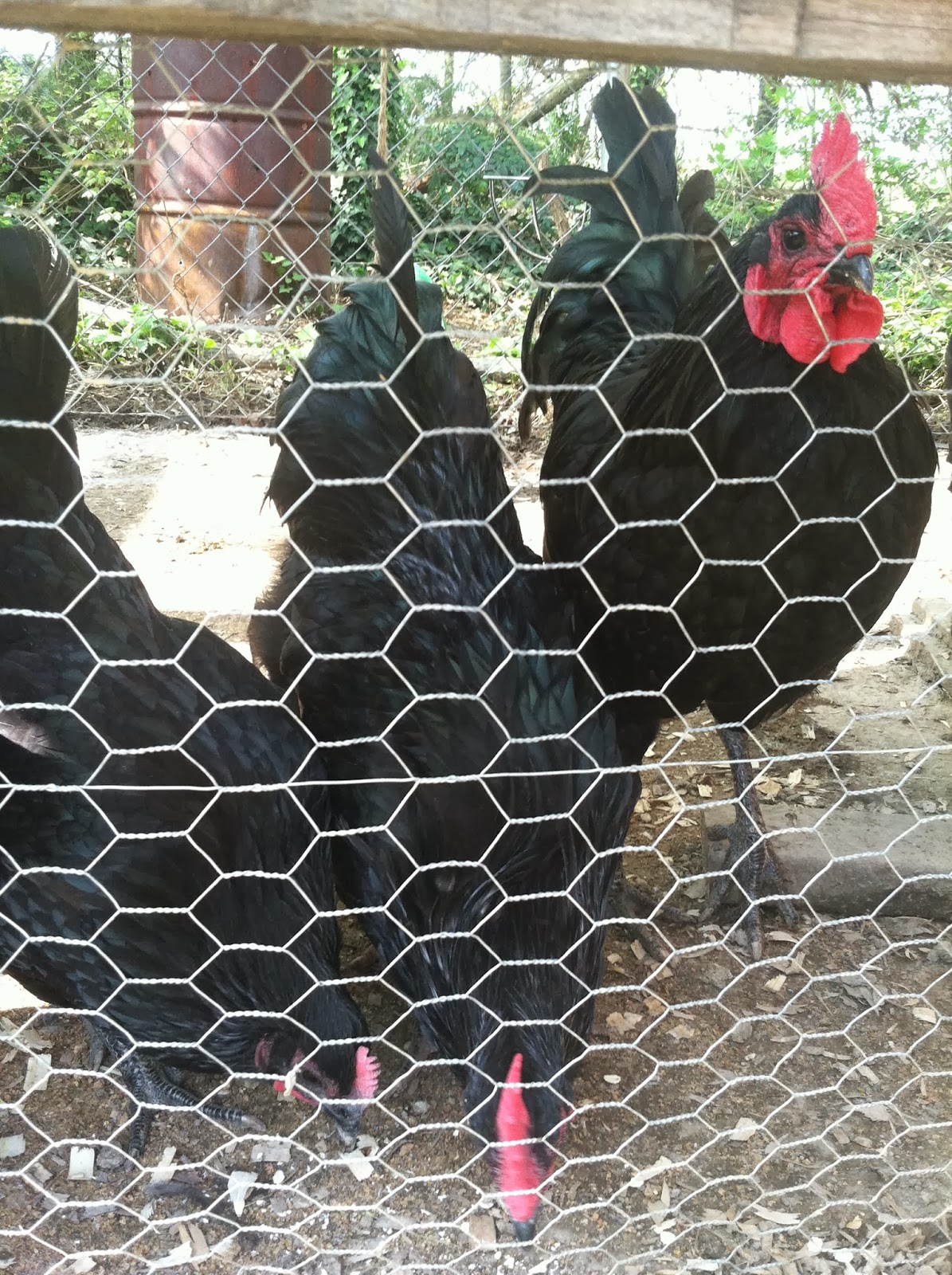
   I thought it would be fun to highlight a specific breed of farm animal every month and of course I had to start with my favorite! Our current flock started with a dozen Black Australorp chicks and my daughter raised a dozen more for 4-H. I honestly wasn't too thrilled about my husbands breed choice at first. They seemed boring to me and I wanted a fancy, colorful bird. As chicks they were quite skittish and I was worried they weren't going to let us handle them (I love snuggling my animals). Go figure as they grew I fell head over heels for these chickens.
   Black Australorps originate from Australia and were bred from Black Orpingtons, hence their name. They're considered a heritage breed and according to the American Livestock Conservancy are recovering. So, by keeping this breed of chicken your helping to keep part of the history of homesteading alive. How cool is that?!?! If you want to know more about heritage breeds I suggest you visit http://www.livestockconservancy.org/. There's so much to love about the Black Australorp so I put together a breed summary with lots of pictures...

                                                           BLACK AUSTRALORP

  • Breed Purpose- These are dual purpose chickens, meaning they are used for eggs and meat. They are fast growing with roos coming in at about 8.5lbs. and hens at 7lbs. We have butchered three Australorps and got quite a bit of delicious, tender meat from them.
       
  • One of the Australorp roosters that we butchered
  • Temperament- Australorps have to be one of the sweetest breeds we own. Our girls follow us around like little puppies and we hold them constantly. Our girls are very chatty as well, they talk and talk all day! As for the roos, they take their job seriously. They always keep an out for their hens and run them to safety if need be. With that said, I've been spurred on three separate occasions, by three different Australorp roosters (these would be the ones we butchered), So if you're looking for a rooster with some people skills, this probably isn't the breed for you.
                                                                    My sweet Tallulah

  • Egg Laying- These chickens are fabulous egg layers. Black Australorps have broken the world egg laying record on several different occasions. One Australorp hen even went as far as laying 364 eggs in 365 days! They're winter hardy so, they'll continue to lay through the cold weather season. They lay large, light brown eggs.
                                                                     Australorp eggs
  • Broodiness- I've seen many websites classify the Australorps broodiness as "average". From experience I can say that seems accurate. We had a few of our girls go broody this year but, not all of them. If you're thinking about hatching eggs under a hen, I would definitely recommend this breed. One of our Australorps recently hatched two chicks and she has been an excellent mother. She's very watchful and protective of her babies, but has always allowed us to handle them.
                                                    Mama our Australorp hatching chicks
                                                              Here she is with her babies

   Whether you're just planning out your flock or are looking to add a new breed, I would highly recommend the Black Australorp. They've made an excellent addition to our homestead and we're absolutely in love with our girls. Happy Homesteading!

Thursday, October 10, 2013

Pecking Order


     When we first started keeping chickens I found it completely laughable that these birds, that run around my backyard mindlessly chasing bugs, maintain any kind of order within their flock. Now that we're a year or so into it I can tell you exactly where each of our 30 +/- chickens (I still haven't counted) belong within the chain of command. Pecking order, though it may seem harsh at times, is completely natural and necessary in maintaining happy chickens.
      If you're like us and have more than one rooster (we currently have five) than you'll notice that they establish a pecking order amongst themselves. Your hens will have their own order that doesn't involve the rooster (we'll talk about this in a minute). This determines who will be the flock guardian and the mate for the hens. Roosters are pretty scrappy and they will spur each other. Trust me you don't want to be in the middle of that, so stand back!  The less dominate roosters won't crow and they don't dare attempt any funny business with the girls. I'm not exactly sure how they determine who's in charge but, I can tell you size is not a factor. If you only have one rooster than he's automatically the king.
                                                   The Polish Top-Hat in the back is the
                                                   head honcho and the much larger Sussex
                                                   roo up front is lower in the pecking
                                                   order.

                                                    Tessa the Langshan is at the very bottom
                                                    of the totem pole.


  Now the hens will also establish a pecking order amongst themselves. This determines who eats and drinks first and who gets dibs on the best roosting spot. The girls will literally peck one another on the head or the back of the neck. You may notice them getting into small tiffs, but don't worry they usually don't last long and again this a necessary process. With that said, there are a few circumstances in which you should intervene...
  • BLOOD/INJURY- If a chicken has been pecked or with roosters spurred to the point where blood has been drawn remove them from the flock. Keep them separate until they are healed. Obviously you don't want an injury getting infected, but also because the other birds will pick on the injured chicken, sometimes to death...literally. Chickens show no mercy!
  • NOT EATING- If you notice that one of your chickens is losing weight, they may not be getting a turn at the feed and/or water. Some birds are just so submissive they can't muster up the courage to push their way to the feeder. In this case I would remove them, nurse them back to health, and then return them to the flock to try again.
  • SLEEPING ON THE FLOOR- Again this is because a bird is very submissive and won't fight for a spot on the roost. Some chicken keepers may not think this is a big deal, but I don't like my birds sleeping on the floor and especially not in the nest boxes. This is a problem we personally have addressed within our flock. Chickens keep warm at night by huddling together on the roost, so a bird alone on the floor is going to be cold, and depending on the weather could die. As for sleeping in the nest boxes well, its just gross! I don't want poop on my egg the next day! To correct the problem my husband would go to the coop after everyone was nestled in for the night and pick the girls up off the floor and set them on the roost. It takes a couple tries, but eventually they'll get up there on their own.
     We are constantly adding new birds to the flock and I can happily say we've never had any serious injuries or mishaps. For the most part your chickens will work everything out on their own. And once the pecking order is determined you'll have happy, orderly birds. Happy Homesteading!

Wednesday, October 9, 2013

Getting Our Ducks in a Row


   When we moved into our new house, which has a creek running through the property, my first thought was DUCKS!!! Lets face it people they are the cutest feathered animals on earth. As far as homesteading goes they lay huge eggs and can be raised for meat purposes, though I've read that duck meat is greasy. So a week ago we brought home two Pekin ducklings and as usual made some mistakes. We decided they would be too cold in our usual brooder (its too big for only 2 birds) so into a cardboard box they went with a small heat lamp. So begins mistake number one. By the next afternoon they were panting like crazy. We were unaware of their exact age and apparently they were old enough to maintain their own body temperature...so off went the heat lamp.


                                                           The ducks in their box

     Next lesson, ducks are MESSY!!!! We only provide our ducks with a small dish of water, just enough to drink, and yet it ends up everywhere in a matter of minutes, same with their food. They soaked through a cardboard box within a day so we started layering newspaper and wood chips to help with the moisture.
                                                               The layering process
  
   Now that we have the basics down we're doing okay...at least for now. So, here are a few quick duck tips...

                                                                   Duck Tips
  • Ducklings start off by eating standard non-medicated chick starter
  • They are social birds and create family bonds that they keep for life so, you need more than one duck to keep them happy.
  • DUCKLINGS CAN DROWN!!! This was news to me. When you provide them with a wading pool or in our case, a creek, you need to make sure they can get in and out safely on their own.
  • Duck feet are sensitive and easily injured. No wire or rough surface material should be used in their brooder or permanent housing.
  • Ducks are very affectionate. Unlike chicks they love to be snuggled so, handle them often. Trust me you wont be able to resist!
                                                               Ducky Snuggles

Happy Homesteading!